Health systems can’t improve what they can’t see. Connecting clinical and operational data enables leaders to surface variation, standardize workflows, and build a repeatable engine for quality, efficiency, and growth.
 Download
Leaders of clinical operational improvement carry a complex mandate. Grow unique patient visits. Maintain high throughput. Manage expense. Collect payment. Hit budget targets. Deliver safe, high-quality care.
All while facing physician burnout, workforce shortages, supply constraints, and rising variability across care sites.
Yet, most clinical improvement efforts still unfold in isolation–focused on clinical metrics alone or disconnected from the operational workflows that truly determine operational performance.
The best-performing organizations close this gap. They treat clinical quality improvement (CQI) not just as a clinical imperative, but as an operational strategy that enables consistency, efficiency, and better use of staff, space, and resources.
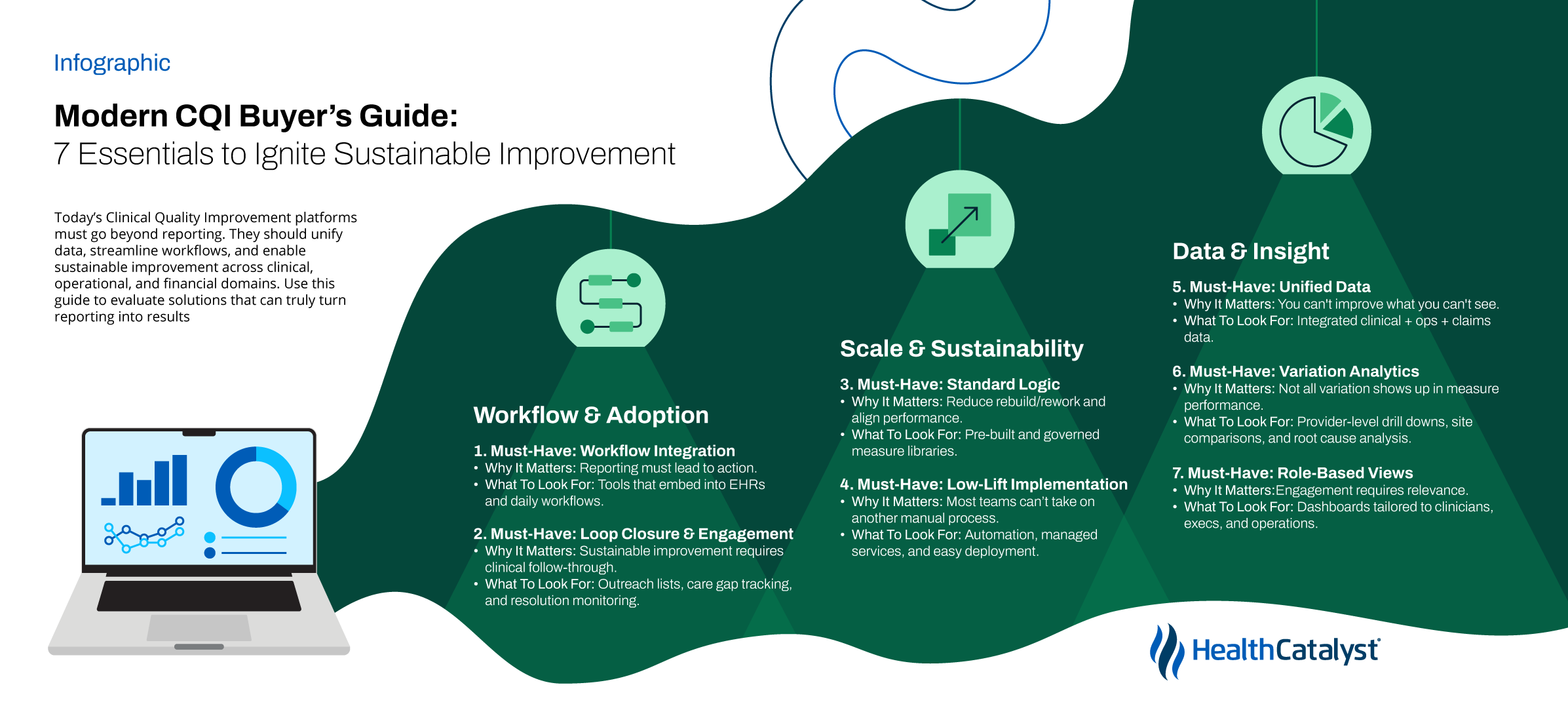
The Clinical Quality Improvement Playbook and Modern CQI Buyer’s Guide identify seven essentials defining a modern CQI platform. For ambulatory and clinical operations leaders, these three are mission-critical to improving performance across sites and service lines.
Operations leaders can’t improve what they can’t see. To drive real efficiency, they need a comprehensive view that connects quality, throughput, staffing, discharge times, denials, and resource utilization–all in one view.
When data from clinical, financial, and operational systems come together, leaders can quickly identify trends, bottlenecks, and variations that impact performance and margins, surfacing insights that support the Quadruple Aim and drive measurable improvement.
Buyer's Guide Connection:
Must-Have: Unified Data
Why It Matters: You can’t improve what you can’t see.
Variation is the hidden driver of inefficiency. Different workflows, discharge times, documentation practices, and care pathways lead to avoidable delays, unnecessary waste, and lower capacity utilization.
With variation analytics, operations leaders can pinpoint where care processes differ and apply proven workflows across facilities to improve performance without adding labor or capital.
Buyer's Guide Connection:
Must-Have: Variation Analytics
Why It Matters: Provider-level comparisons surface actionable patterns.
Every time a new measure, visit productivity report, or operational dashboard is built from scratch, teams lose time and create inconsistencies.
Standardized logic and governed definitions enable every site, service line, and leader to measure performance the same way–accelerating improvement across the network.
Buyer's Guide Connection:
Must-Have: Standard Logic
Why It Matters: Consistency drives scalability.
What is clinical operational improvement? Clinical operational improvement links CQI with operational workflows to improve throughput, reduce waste, and create consistency across sites of care. It relies on unified clinical, financial, and operational data–allowing leaders to standardize best practices and scale improvement efforts.
Cone Health needed a clearer, more actionable view of its performance across multiple payer contracts–but fragmented, delayed metrics and inconsistent rules made it difficult for operational and clinical leaders to intervene in time to improve outcomes.
By unifying payer rules and clinical quality data into a single analytics application, Cone Health gained a real-time operational foundation to drive performance improvement and accelerate value-based results.
With a consolidated platform and AI-driven forecasting, leaders could finally visualize performance against pay-for-performance targets, identify clinical and operational gaps, and prioritize improvements with the greatest impact. The results:
“By aligning payer rules with quality data, we gained clarity and foresight–Healthcare.AI forecasting gave us confidence to act decisively and maximize performance outcomes.”—Emily Paula, MBA/MHA, CPHQ, Director of Quality Informatics, Cone Health
Margins are tightening. Labor pools are shrinking. Demand for access is rising.
In today’s environment, reactive improvement no longer works. When ambulatory and operations leaders support improvement with unified data, standardized logic and repeatable methods, CQI becomes the foundation for operational reliability and scalability, helping leaders:
Quality improvement becomes operational improvement. And operational improvement becomes sustainable.
Want to see how other organizations are linking operational efficiency with clinical improvement? See how leading health systems are using integrated data to standardize performance and sustain measurable gains.