Quality improvement in healthcare starts not with dashboards, but with physician engagement, clinical dialogue, and data that earns trust. CMOs can accelerate quality improvement in healthcare by integrating data into clinical workflows and giving physicians a reason to care about the numbers.
 Download
.jpg)
Physician leaders across the industry know this truth: real, meaningful clinical quality improvement strategies don’t happen in spreadsheets; they happen in conversations.
Too often, data fails to spark those conversations because physicians don’t trust it, don’t see it soon enough, or don’t see its relevance to their own practice.
When data feels disconnected from reality, engagement drops. Improvement stalls. Variation persists.
The solution isn’t more reports—it’s insights that are meaningful, timely, and actionable for physicians.
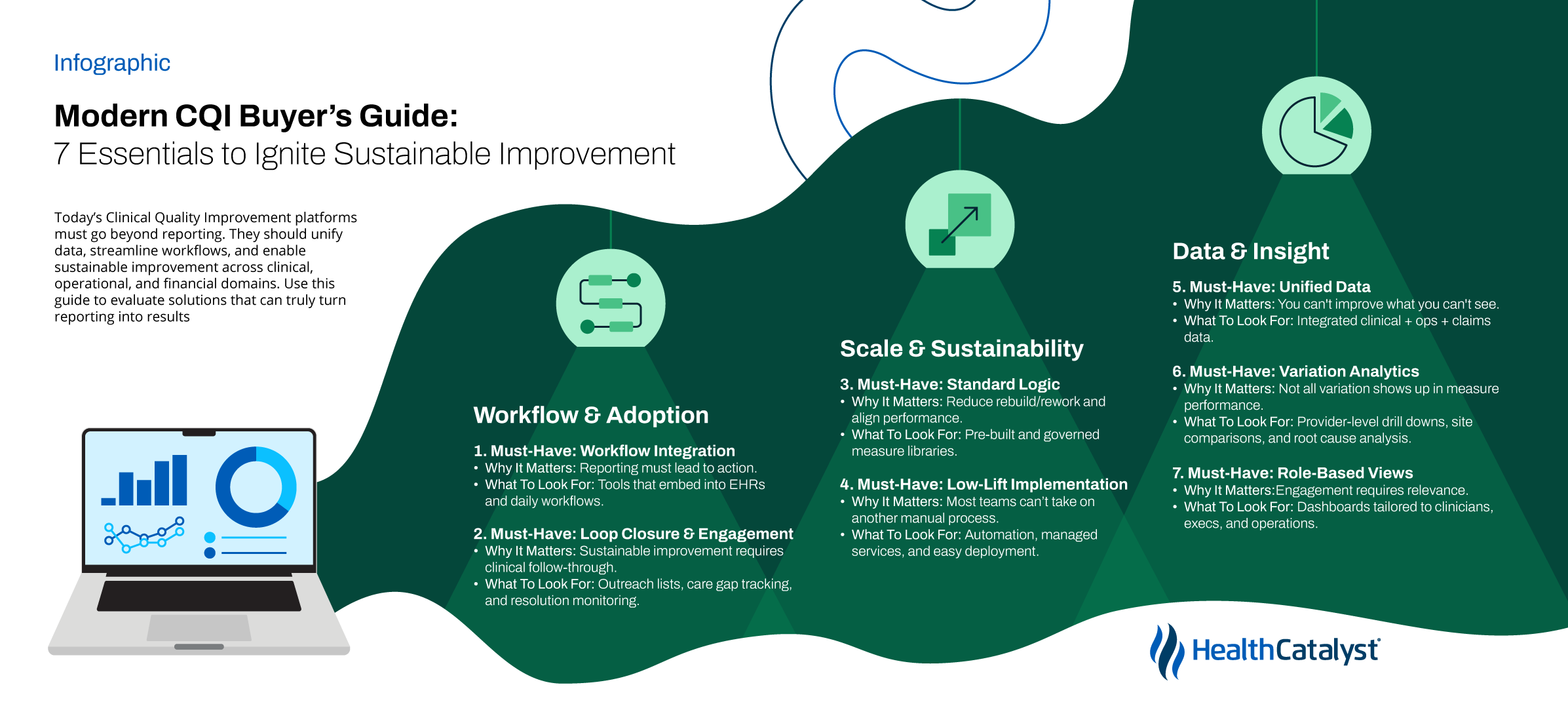
The Clinical Quality Improvement Playbook and Modern CQI Buyer’s Guide outline seven must-haves for a modern clinical quality improvement (CQI) platform. For CMOs and physician leaders focused on quality improvement in healthcare, these three drive the most immediate impact:
When working towards quality improvement alignment, it is key to connect both worlds. CMOs need role-based dashboards that contextualize data for each audience: system-wide performance for leadership and provider-level results for clinicians. When physicians can see how they compare to peers, the conversation shifts from compliance to collaboration.
Buyer’s Guide Connection:
Must-Have: Role-Based Views
Why It Matters: Engagement requires relevance.
No one has time to chase reports. Insight must meet physicians where they work—in the EHR, during morning huddles, or during service-line reviews. Integrated workflows turn analytics from quarterly exercises into daily decision-making habits.
Buyer’s Guide Connection:
Must-Have: Workflow Integration
Why It Matters: If it’s hard to find, it won’t be used.
Peer comparison is only effective when it’s transparent, timely, and trusted. Variation analytics enable CMOs to identify meaningful gaps, highlight best practices, and facilitate evidence-based conversations about quality improvement in healthcare.
Buyer’s Guide Connection:
Must-Have: Variation Analytics
Why It Matters: Not all variation shows up in measure performance.
Like many health systems, Cone Health struggled with delayed visibility into hospital-acquired conditions and safety-grade performance, limiting leaders’ ability to act on emerging risks. To close this gap, the organization unified real-time safety data—spanning hospital-acquired conditions and CMS Patient Safety and Adverse Events Composite (PSI 90) metrics—into a single, actionable view.
With advanced healthcare data and analytics, leaders and care teams could forecast performance, pinpoint high-impact opportunities, and strengthen evidence-based practices. Real-time dashboards and predictive modeling gave clinicians the insight—and confidence—to intervene earlier, improve documentation, and prevent avoidable harm.
The results:
Cone Health also established a sustainable analytics foundation, empowering faster action, stronger clinical alignment, and measurable gains in patient safety and care quality.
As payors and boards tie more performance to outcomes, CMOs are experiencing growing pressure to demonstrate progress and secure physican belief at the same time.
The path forward is clear: build trust through transparency, integrate data into clinical workflows, and engage physicians in the conversation, so their insights are built into the solution.
Because lasting quality improvement in healthcare doesn’t begin with a dashboard—it begins with dialogue.
To advance quality improvement in healthcare, CMOs must embed analytics into clinical workflows and create physician-centered strategies for engagement. Learn how Health Catalyst supports this shift through data integration, AI-driven insights, and clinical collaboration models.