Chief Medical Information Officers (CMIOs) are pivotal in transforming healthcare data into actionable insights. Yet, many are bogged down by fragmented systems and manual processes. This article explores three essentials CMIOs need to drive enterprise-wide, evidence-based improvement:
1. Standard logic for consistent, trusted measures.
2. Low-lift implementation to reduce IT burden.
3. Workflow integration to deliver insights at the point of care.
Learn how one health system closed 373,000 care gaps in six months by adopting these strategies—and why scalable clinical quality improvement (CQI) matters now more than ever.
 Download
Clinical leaders agree that high-performing healthcare organizations are those that consistently, reliably, and at scale achieve data-driven clinical quality improvement (CQI).
Chief Medical Information Officers (CMIOs) sit squarely at the intersection of clinical practice, data architecture, and operational workflows, giving them a uniquely powerful vantage point when it comes to CQI. Yet too often, their teams are consumed by:
To move from data chaos to clinical clarity, CMIOs need systems designed to support evidence-based improvement across the enterprise.
The role of CMIO in clinical quality improvement. CMIOs bridge clinical practice, data architecture, and operational workflows, making them crucial for turning healthcare data into actionable insights. Their leadership ensures standardized logic, streamlined implementation, and workflow integration—key elements for consistent, enterprise-wide quality improvement.
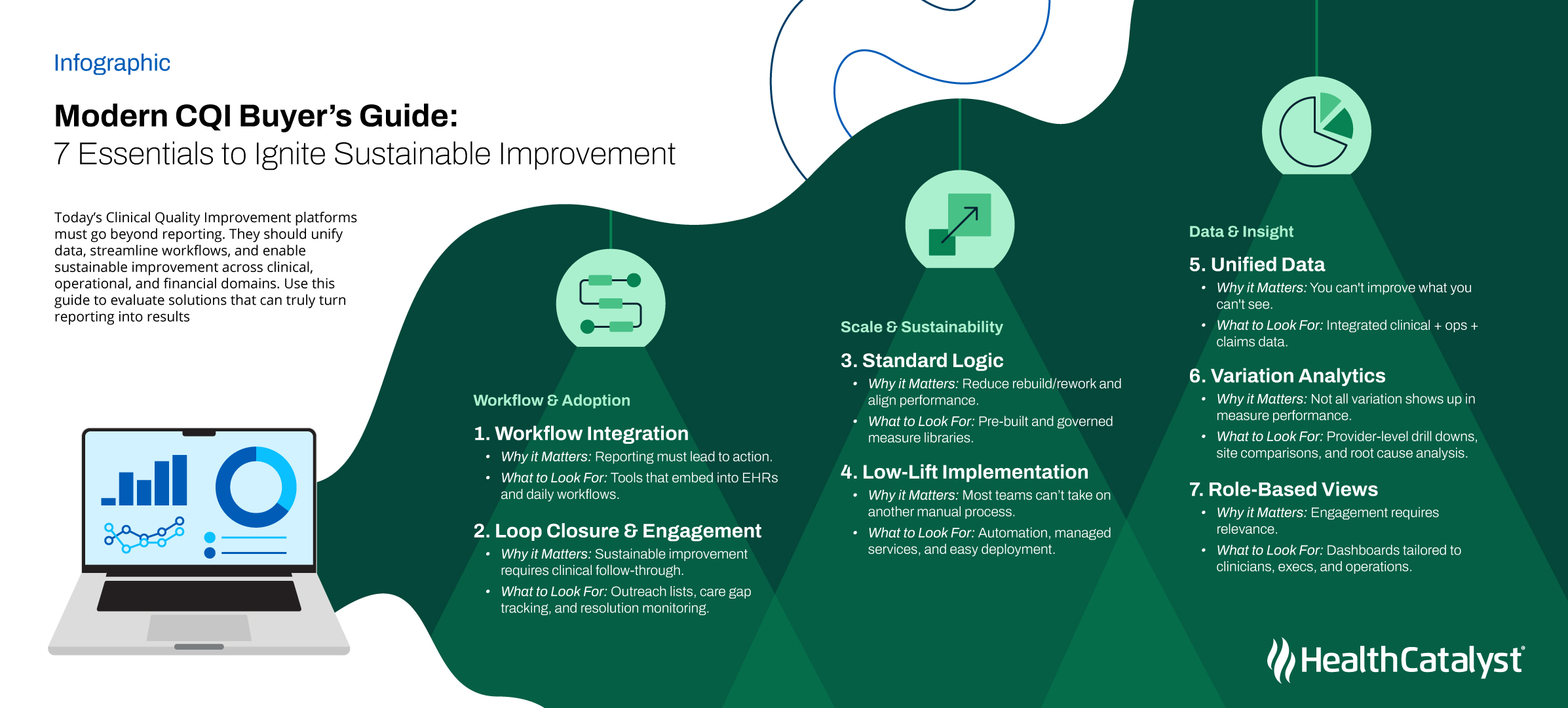
The Clinical Quality Improvement Playbook and Modern CQI Buyer’s Guide outline seven features of a modern improvement platform.
For CMIOs, these three unlock the most strategic value:
Organizations cannot achieve evidence-based quality improvement when every department defines and calculates measures differently.
Custom logic and bespoke interfaces lead to:
Standardized, governed measure logic—applied across the EHR, dashboards, and reports—ensures everyone is working from the same version of the truth. This reduces conflicting interpretations, fosters alignment, and accelerates improvement efforts.
What is standard logic in clinical quality improvement? Standard logic means using governed, consistent measure definitions across all systems—EHRs, dashboards, and reports. This eliminates conflicting interpretations, reduces reworks, and accelerates improvement by ensuring everyone works from the same version of the truth.
Must-Have: Standard Logic
Why It Matters: Consistency and trust enable enterprise alignment and accelerate data-driven action.
Informatics teams are strained. They need technology that:
Solutions with pre-built connectors and governed content reduce IT overhead and free up informatics teams to concentrate resources on what matters—enabling clinicians rather than troubleshooting analytics tools.
Must-Have: Low-Lift Implementation
Why It Matters: Reduces manual burden and frees teams to focus on strategic improvement work.
Improvement only happens when clinicians actually use the data. That means insights must be:
Embedding targeted, reliable intelligence into clinical workflows ensures healthcare data directly improves quality, supporting evidence-based decisions in real time.
Must-Have: Workflow Integration
Why It Matters: Real-time context drives real-world clinical impact.
Why is workflow integration critical for clinical quality improvement? Workflow integration ensures that actionable insights are delivered at the point of care—embedded in the EHR and rounding tools—so clinicians can make evidence-based decisions in real time, improving outcomes and accelerating quality initiatives.
When these foundational elements are in place, health systems can use healthcare data to improve quality consistently and sustainably. Community Health Network (CHNw) illustrates how a data-driven approach to clinical quality improvement delivers measurable results.
The health system faced growing pressure to report hundreds of quality measures and simultaneously support frontline improvement.
By adopting unified data collection, normalization, and standardized measurement logic—powered by Health Catalyst MeasureAble™ and Ignite—CHNw significantly advanced its evidence-based improvement capabilities.
Results:
This example represents the promise of true data-driven quality improvement: trusted data, delivered consistently, where care happens.
Clinical informatics leaders and teams are under unprecedented pressure to deliver accurate, enterprise-wide insights with fewer resources, all while responding to regulatory demands, rising clinician expectations, and shrinking budgets.
The future of scalable CQI requires:
With Health Catalyst, CMIOs can finally provide trusted, timely, actionable data that drives sustained improvements and better patient outcomes.
Ready to reduce burden and accelerate data-driven impact? See how leading informatics leaders are standardizing logic and bringing insight directly into clinical care.
Access the Clinical Quality Improvement Playbook