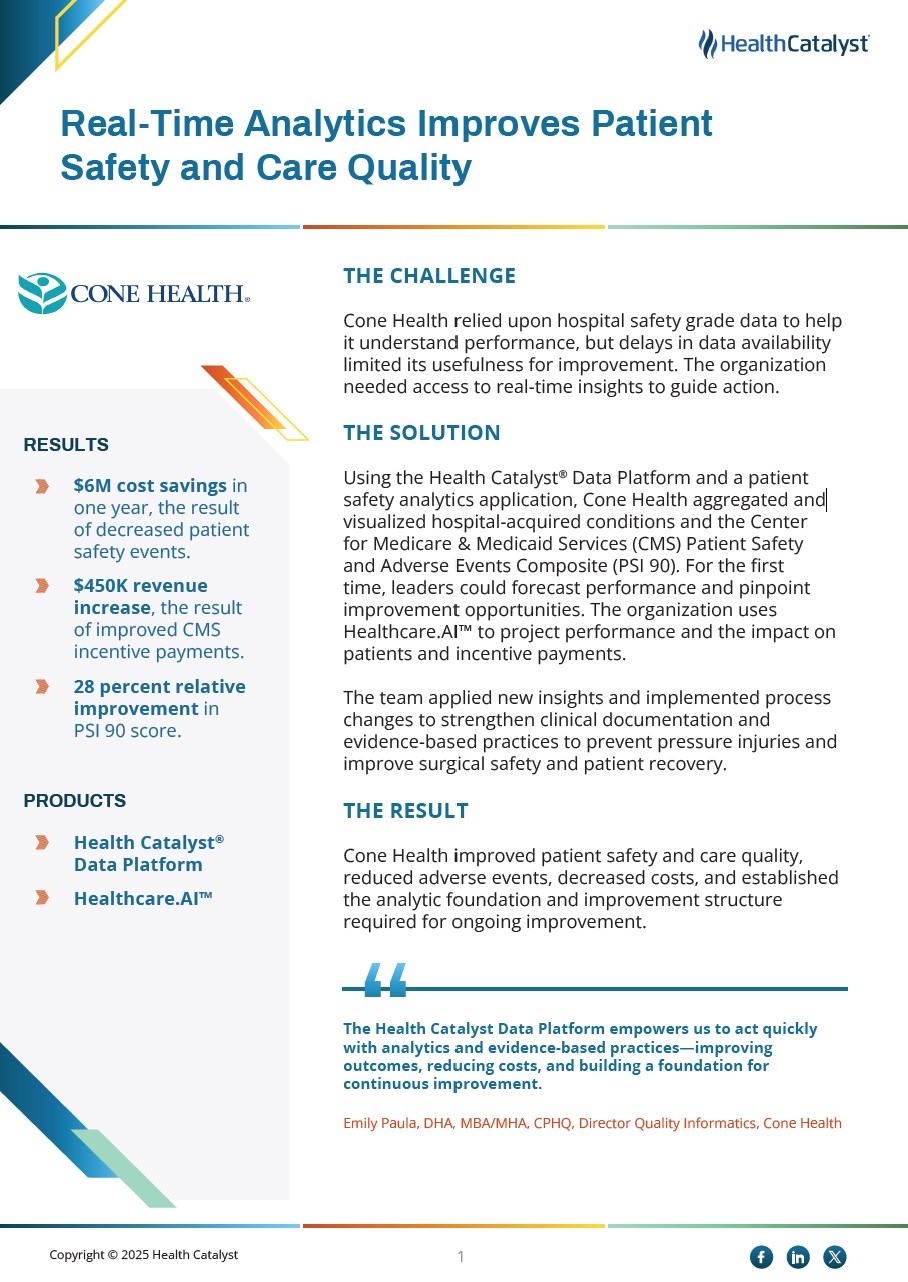
Cone Health faced challenges with delayed hospital safety grade data, prompting the need for real-time insights to enhance patient safety and care quality. By leveraging the Health Catalyst® Data Platform and implementing a patient safety analytics application, the organization successfully identified improvement opportunities and implemented process changes, resulting in significant cost savings and improved performance metrics. As a result, Cone Health improved patient safety and care quality, reduced adverse events, decreased costs, and established the analytic foundation and improvement structure required for ongoing improvement.
Cone Health relied upon hospital safety grade data to help it understand performance, but delays in data availability limited its usefulness for improvement. The organization needed access to real-time insights to guide action.
Using the Health Catalyst® Data Platform and a patient safety analytics application, Cone Health aggregated and visualized hospital-acquired conditions and the Center for Medicare & Medicaid Services (CMS) Patient Safety and Adverse Events Composite (PSI 90). For the first time, leaders could forecast performance and pinpoint improvement opportunities. The organization uses Healthcare.AI™ to project performance and the impact on patients and incentive payments.
The team applied new insights and implemented process changes to strengthen clinical documentation and evidence-based practices to prevent pressure injuries and improve surgical safety and patient recovery.
Cone Health improved patient safety and care quality, reduced adverse events, decreased costs, and established the analytic foundation and improvement structure required for ongoing improvement.
"The Health Catalyst Data Platform empowers us to act quickly with analytics and evidence-based practices—improving outcomes, reducing costs, and building a foundation for continuous improvement."
- Emily Paula, DHA, MBA/MHA, CPHQ, Director Quality Informatics, Cone Health